ISO 9001:2026 Transition Guide
ISO 9001:2026 – Preparing Your Business for the New Standard
ISO 9001 is evolving. The 2026 revision brings a harmonised structure, a stronger focus on risk and opportunity, and - for the first time - explicit requirements around climate change and quality culture. Businesses currently certified to ISO 9001:2015 will have a three-year transition window to adapt, but the organisations that start preparing now will be the ones that move through certification with the least disruption.
Book a Free ISO 9001:2026 Readiness Assessment
From the consultation you will:
- Speak directly to an ISO 9001 specialist
- Understand exactly how the 2026 changes affect your current QMS
- Get a clear, prioritised plan for closing any gaps before the transition deadline
Why Does ISO 9001 Need to Change for 2026?
ISO reviews every standard at least once every five years to make sure it still reflects how organisations actually operate, and a lot has changed since 2015.
Hybrid and remote working is now the norm, customers and regulators expect visible ESG commitments, and digital tools have replaced much of the paperwork that used to define a quality management system.
The 2026 revision of ISO 9001 responds directly to that shift. It aligns the standard with ISO's Harmonised Structure so that ISO 9001 stays consistent with other management system standards such as ISO 14001 and ISO 45001, making integrated management systems easier to run. It also builds on the climate change amendment already introduced in 2024, formalising it as a core requirement rather than an add-on.
For any business that depends on ISO 9001 certification to win tenders, reassure customers, or run an efficient operation, the message is simple: the standard is not standing still, and neither should your quality management system.
What's Changing in ISO 9001:2026?
The core requirements of ISO 9001 are not being rewritten — this is an evolutionary update, not a replacement. But several targeted changes will affect how certified organisations plan, document, and demonstrate their quality management system.
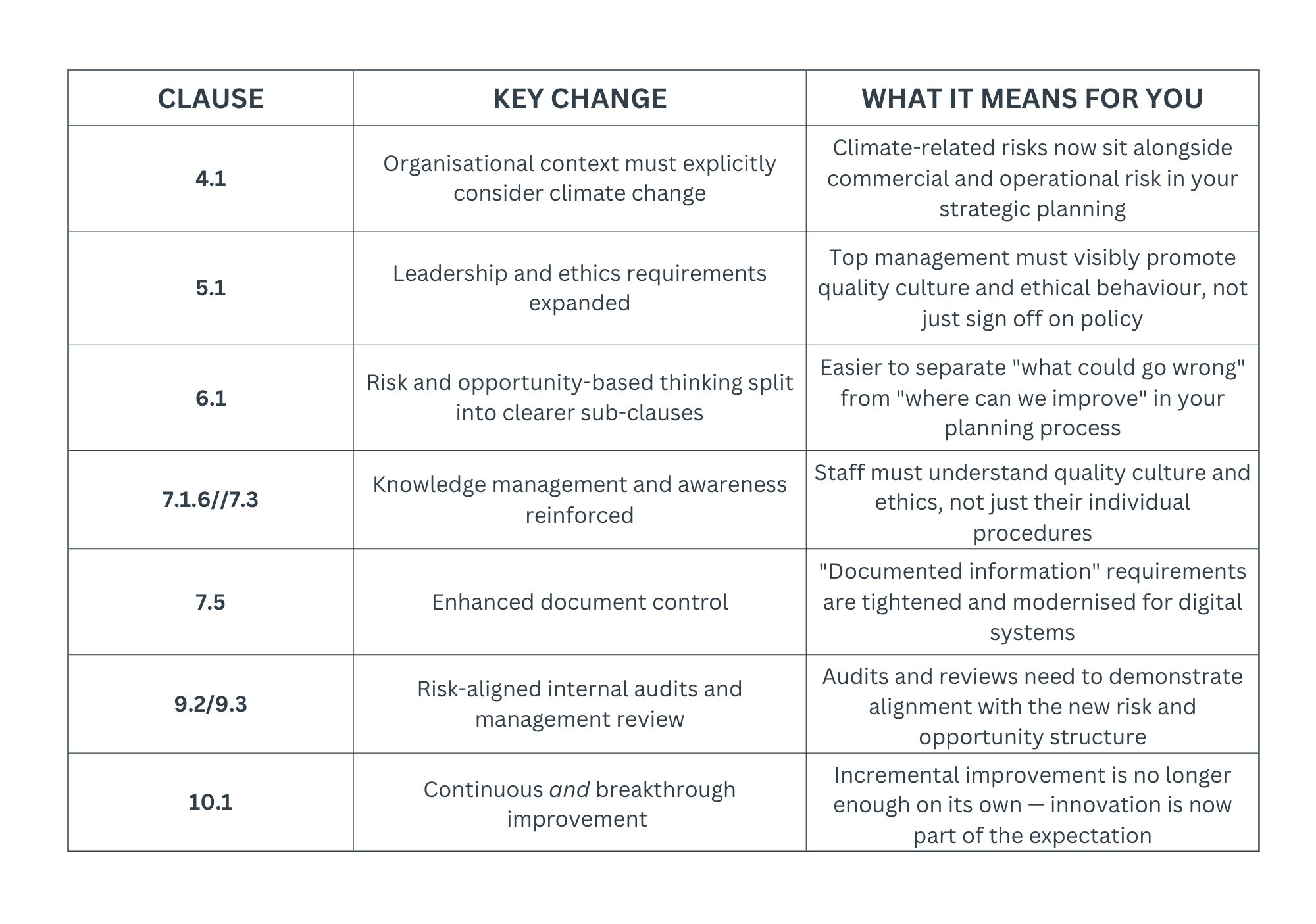
Two themes run through nearly every change: organisations are expected to manage risk and pursue opportunity, and leadership is expected to own quality culture rather than delegate it entirely to a QMS manager.

The Growing Role of Digitisation
One of the quieter but most practical shifts in ISO 9001:2026 is how it treats digital tools. The revision recognises hybrid and remote working as standard practice and expects "documented information" to be managed through modern digital systems — version control, secure access, and virtual audit evidence — rather than static paper-based files.
For businesses, this is as much an opportunity as a compliance requirement. Moving document control, audit trails, and management review data into a digital QMS makes the 2026 transition easier to demonstrate and makes day-to-day quality management faster to run. It is a good reason to review your document control systems now, even before the formal transition deadline arrives.
Key Dates: The ISO 9001:2026 Transition Timeline
- August 2025: Draft International Standard (DIS) published for public comment
- Expected September 2026: Final publication of ISO 9001:2026
- 2026–2029: Three-year transition period - organisations can certify or migrate to the new standard
- Expected September 2029: ISO 9001:2015 certificates expire; migration must be complete
Three years sounds like a long runway, but certification bodies expect a surge of transition audits as the deadline approaches. Starting your gap analysis early secures audit slots, spreads the cost of change, and avoids a last-minute scramble.
Why Prepare Early? The Benefits
"The upcoming ISO 9001:2026 revision challenges organisations to think beyond certification, to look at embedding quality, sustainability, and innovation at the heart of their strategy. At CG Business Consulting, we see this as a defining moment for businesses ready to future-proof their success."
Caroline Geoghegan, Founder & CEO, CG Business Consulting
-
Reduced Disruption:
Spreading changes to documentation, training, and processes over time rather than compressing them into a single audit cycle
-
Stronger Leadership Engagement:
Building quality culture and ethical behaviour into management practice well ahead of the formal requirement.
-
Better Risk and Opportunity Visibility:
Using the revised clause 6.1 structure to sharpen strategic planning, not just pass an audit.
-
A Head Start on ESG Expectations:
Climate-related risk assessment is already appearing in customer and tender requirements, not just ISO audits.
-
A More Efficient, Digitally-Enabled QMS:
Modernising document control now pays off in both audit readiness and daily operations
How CG Business Consulting Can Help You Transition:
CG Business Consulting is Ireland's leading ISO and sustainability consultancy, having guided over 1,000 organisations — including Toyota Ireland, Twitter, and Irish Distillers — to ISO certification. Our team is already working with clients on ISO 9001:2026 readiness, well ahead of formal publication.
Our approach to the transition mirrors the same proven methodology behind our 100% ISO certification success rate:
Gap analysis — we assess your current ISO 9001:2015 QMS against the new 2026 clauses, identifying exactly where climate context, leadership, digital documentation, and risk-and-opportunity thinking need attention.
Leadership and culture support — we help top management build the visible commitment to quality culture and ethical behaviour the revision now requires, so it becomes part of how the business runs, not a line in a policy document.
Digital documentation review — we advise on modernising document control and audit evidence so your QMS is ready for digital-first, hybrid working environments.
Transition planning and audit readiness — we build a phased roadmap aligned to the 2026–2029 transition window, so your certification migrates smoothly with no lapse in coverage.
We will work closely with your team to ensure a smooth and easy path through the ISO 9001:2026 transition.
Why are ISO Standards Important?
As the world’s leading Management System Standards, ISO aims to help organisations to establish the framework(s) required to achieve optimal business performance. ISO standards cross over multiple aspects of business operations.
Book a Free ISO 9001:2026 Readiness Assessment
From the consultation you will:
- Speak directly to an ISO 9001 specialist
- Understand exactly how the 2026 changes affect your current QMS
- Get a clear, prioritised plan for closing any gaps before the transition deadline
WANT MORE INFORMATION?
Download the Free Guide: Navigating the Transition to ISO 9001:2026
What you'll learn:- The key changes coming in the ISO 9001:2026 revision, clause by clause
- Why climate change and sustainability are now built into the standard
- The full transition timeline — from DIS publication to certification migration deadline
- Practical steps to prepare your QMS, from gap analysis to digital documentation
- The business benefits of acting early, from risk mitigation to audit readiness
Frequently Asked Questions
-
What is ISO 9001:2026?
ISO 9001:2026 is the upcoming revision of the world's most widely used quality management standard. It keeps the core structure of ISO 9001:2015 but adds explicit requirements around climate change, quality culture, ethical leadership, and refined risk-and-opportunity thinking.
-
When does ISO 9001:2026 come into effect?
The Draft International Standard was published in August 2025, and final publication is expected in September 2026. Certified organisations will then have a three-year transition period, expected to run until September 2029.
-
Will my existing ISO 9001:2015 certificate still be valid?
Yes, during the transition period. ISO 9001:2015 certificates will remain valid until they expire or until the transition deadline (expected September 2029), whichever comes first. After that, organisations must be certified to ISO 9001:2026 to maintain a valid certificate.
-
Do I need to do anything before ISO 9001:2026 is published?
You can start now. A gap analysis against the draft clauses lets you identify where your QMS already meets the new requirements and where you'll need to adjust - for leadership engagement and digital documentation in particular — before the transition window opens.
-
What's the biggest change businesses should prepare for?
Two things stand out: climate change must now be considered explicitly within your organisational context (Clause 4.1), and leadership is expected to visibly own quality culture and ethical behaviour (Clause 5.1), rather than treating quality as a delegated function.
-
How can CG Business Consulting help with the ISO 9001:2026 transition?
CGBC runs a structured readiness programme covering gap analysis, leadership and culture support, digital documentation review, and audit-ready transition planning — built on the same methodology behind our 100% ISO certification success rate. .
-
Is ISO 14001 suitable for small businesses?
Yes, ISO 14001 is scalable and suitable for organisations of all sizes.
ISO Standards
We have the perfect service for your organisation, across a variety of business ISO standards.
Ireland’s Leading ISO Consultancy
BOOK a free consultation
From the consultation you will:
- Speak directly to an ISO professional
- Get expert advice on your business requirement
- Understand the benefits of certification for your business